Early Support and Stronger Communities
When youth crime makes the news, the conversation can quickly turn to punishment, tougher penalties and what should happen after an offence has been committed.
Those are important conversations. Victims deserve to be heard. Communities deserve to feel safe. Young people also need to understand that actions have consequences.
But on this week’s Building Stronger Communities, we asked another question:
What happened before?
Before the police became involved. Before the court appearance. Before the suspension from school. Before the young person became completely disconnected.
And importantly — was there an opportunity to change the direction earlier?
🤝 Earlier Support, Stronger Futures
Our conversation with Angela Raguz, CEO of Marist180, explored why supporting children, young people and families earlier matters.
Rather than waiting until a family or young person reaches crisis, we looked at what can happen when support is available earlier and the importance of keeping young people connected to family, education and community.
It raises an important question for all of us:
If we want safer communities tomorrow, how much should we invest in supporting children and families today?
🎧 Listen: Angela Raguz – Marist180
🧠 Brain Energy with Luke Evans
Our regular Brain Energy contributor Luke Evans joined us with another opportunity to look at what’s happening beneath the surface.
Luke’s segments remind us that our thoughts, emotions, behaviour and ability to respond to difficult situations don’t exist independently of what’s happening in our brain and body.
That fits particularly well with this week’s conversation.
When we’re looking at the behaviour of a child or young person, it’s easy to focus entirely on what they did.
Understanding what’s happening underneath that behaviour doesn’t mean removing consequences or accountability. It gives us another piece of information that may help us respond more effectively.
🎧 Listen: Brain Energy with Luke Evans
🏫 Are We Asking the Right Question About Behaviour?
We had arranged to speak with Nikki from Life Skills Go, following her article exploring the student behaviour question schools perhaps aren’t asking. Unfortunately, Nikki was not well on the day and we wish her a speedy recovery. We will have Nikki on the program at a later date.
When a young person is disruptive, aggressive or repeatedly disengaging from school, consequences may be necessary — particularly where their behaviour affects other students, teachers or the learning environment.
But alongside:
“How do we stop this behaviour?”
perhaps we also need to ask:
“What is happening for this young person?”
Understanding the reason behind behaviour doesn’t mean excusing it. It may help identify a response that reduces the chance of the behaviour continuing.
🎧 Listen: Nikki – Life Skills Go
Nikki was unable to join us – More Information on Life Skills Go can be found here.
🔄 Could Suspension Become a Circuit Breaker?
One practical example we explored was The Y NSW’s Alternative Suspension program.
Marta Vasquez joined us from the Y Penrith to explore the program.
Rather than suspension simply meaning time away from school, the program works alongside young people, families, schools and local services to address issues sitting behind disengagement and support a positive return to learning.
Since the Penrith program commenced earlier this year, more than 40 young people from local schools have participated, with an average participant age of just 14.
Across NSW, 664 young people participated between February 2023 and June 2026. In a three-month follow-up sample of 110 participants, 59% had not received another suspension, disciplinary sanctions reduced by 44%, and engagement with learning improved by an average of 30%.
One idea from the program particularly resonated with us:
A circuit breaker.
A difficult period in a young person’s life does not necessarily have to determine what happens next.
🎧 Listen: Marta Vasquez – Y NSW Penrith
👀 Through Young Eyes with Piper
An episode about young people shouldn’t be two hours of adults simply talking about young people.
Piper brought the youth perspective through Through Young Eyes, including a story about the difference a trusted adult can make at an important point in a young person’s life.
It led us to consider something important:
Early intervention doesn’t always begin with a formal service or program.
Sometimes it’s a teacher who notices.
A coach who asks why someone hasn’t been at training.
A family member who keeps showing up.
A youth worker who builds trust.
Or simply an adult who says:
“You don’t seem yourself. What’s going on?”
And then genuinely listens.
🎧 Listen: Through Young Eyes with Piper
🏉 Local Locker Room with Bethanie
Bethanie joined us for the Local Locker Room, but this week’s sporting conversation also connected strongly with our broader theme.
Community sport can provide much more than physical activity.
For young people it can mean routine, friendships, responsibility, mentors, coaches and somewhere to belong.
We reflected on the story of Socceroo Awer Mabil — not as a youth-crime story, but as an example of opportunity, community and belonging.
Sometimes the adult who notices a young person isn’t themselves isn’t their parent or teacher.
Sometimes it’s their coach.
🎧 Listen: Local Locker Room with Bethanie
📢 Community Announcements with Siv
Building stronger communities also means knowing what’s happening in them.
Our regular contributor Siv brought us this week’s Community Announcements, sharing opportunities, activities and information from across our Western Sydney community.
It’s a simple but important part of the program — helping people discover what’s happening around them and providing another way for people to connect, participate and belong.
🎧 Listen: Community Announcements with Siv
📵 Switch Off & Connect
This week’s Switch Off & Connect challenge was for the adults:
Spend some time with a young person — and listen.
Don’t make it an interrogation.
Go for a drive. Walk the dog. Kick a ball. Grab something to eat.
Put the phone away.
And rather than immediately trying to fix whatever they tell you, listen first.
We asked Piper and Bethanie one final question:
What’s one thing an adult can do that makes it easier for a young person to talk to them?
Sometimes connection doesn’t require a program.
It requires time.
❤️ Accountability and Understanding Can Coexist
Perhaps one of the most important messages from this episode is that this doesn’t have to be an either/or conversation.
We can care about victims and ask how we prevent future victims.
We can expect accountability and try to understand what’s driving behaviour.
We can have consequences and provide pathways back.
We can protect our communities and intervene earlier when a child begins to disconnect.
Understanding what happened before does not erase responsibility for what happens afterwards.
But if our shared goal is fewer victims, fewer young people becoming involved in crime and safer, stronger communities, prevention deserves to be part of the conversation.
So perhaps the question isn’t only:
“What should happen to this young person now?”
It’s also:
“What could we have done earlier?”
🎧 Listen to the episode snippets:
Building Stronger Communities
Where everyone has a place and every story matters.
Yes — and I think this gives October’s BSC Mental Health Month a really clear identity: each Saturday explores mental wellbeing from a different angle, rather than every week feeling like another generic “mental health awareness” show.
Next week on BSC
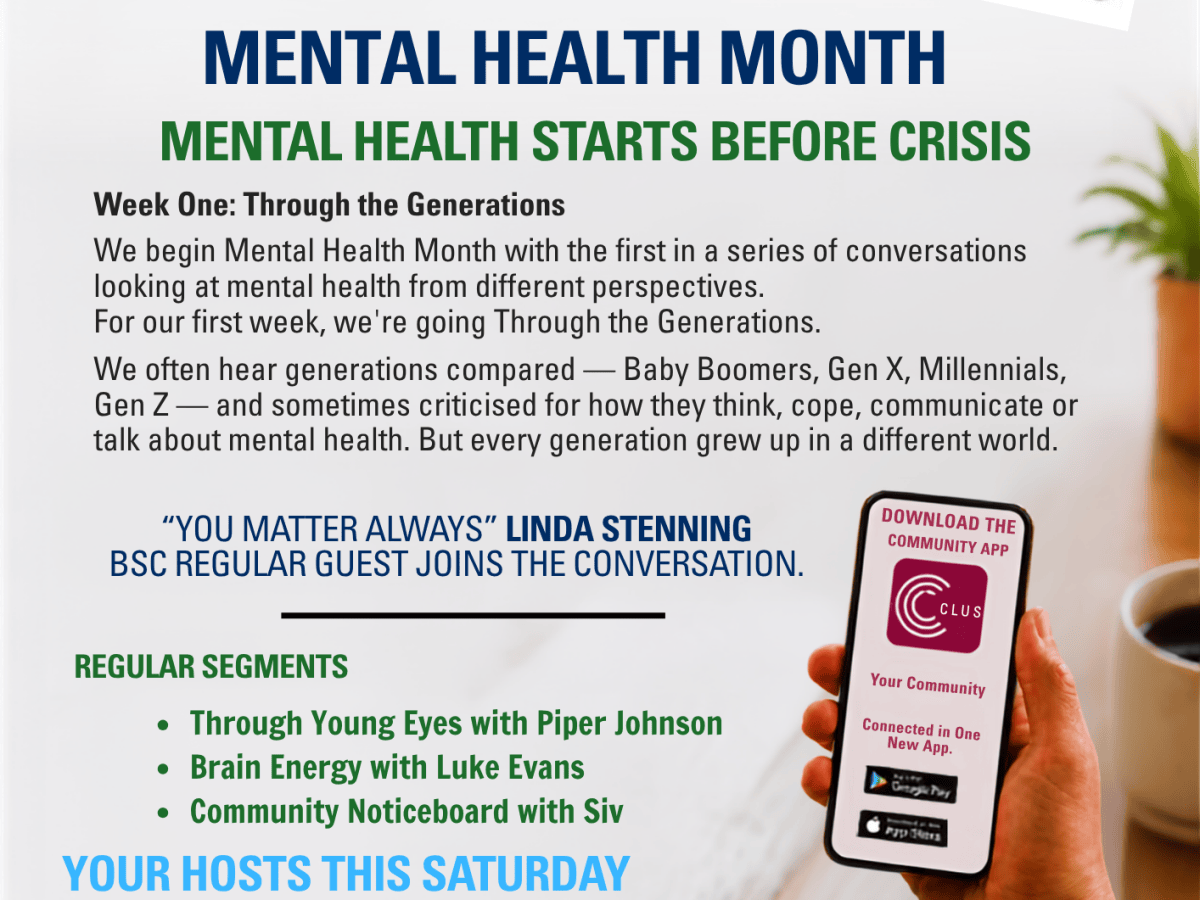
🧠 Mental Health Starts Before Crisis
Week One: Through the Generations
Next week on Building Stronger Communities, we begin Mental Health Month with the first in a series of conversations looking at mental health from different perspectives.
For our first week, we’re going Through the Generations.
We often hear generations compared — Baby Boomers, Gen X, Millennials, Gen Z — and sometimes criticised for how they think, cope, communicate or talk about mental health.
But every generation grew up in a different world.
For some older Australians, mental illness was rarely spoken about. You got on with things, kept personal problems private and often didn’t have the language we have today.
Younger generations have grown up with much more awareness and openness around mental health — but they’re also navigating pressures and experiences previous generations didn’t face in quite the same way.
So rather than asking which generation had it harder, we’re asking something much more useful:
What can we learn from each other?
We’ll hear perspectives across the generations and bring our young voices Piper and Bethanie into the conversation too — including what they’ve heard from their own parents and grandparents.
We don’t have to completely understand another generation’s experience.
We don’t even have to agree on everything.
But we can listen.
We can have empathy.
And we can find better ways to support one another before someone reaches crisis.
We’ll also launch BRUSH, our new community mental-wellbeing challenge, exploring how something as simple as brushing your teeth can become a daily reminder to check in with your mental health:
Breathe. Reflect. Understand. Share. Habit.
Plus Brain Energy with Luke Evans, Through Young Eyes with Piper, Local Locker Room with Bethanie, Community Announcements with Siv, and our weekly Switch Off & Connect challenge.
🎙️ Next Saturday, 8–10am
Building Stronger Communities — SWR 99.9 FM
Mental Health Starts Before Crisis: Through the Generations.
Where everyone has a place and every story matters. ❤️




Leave a comment